This article is part of a 27-article series on the AI Business Transformation Methodology. This piece focuses on Phase 3B: the education that must happen before workflow redesign begins.
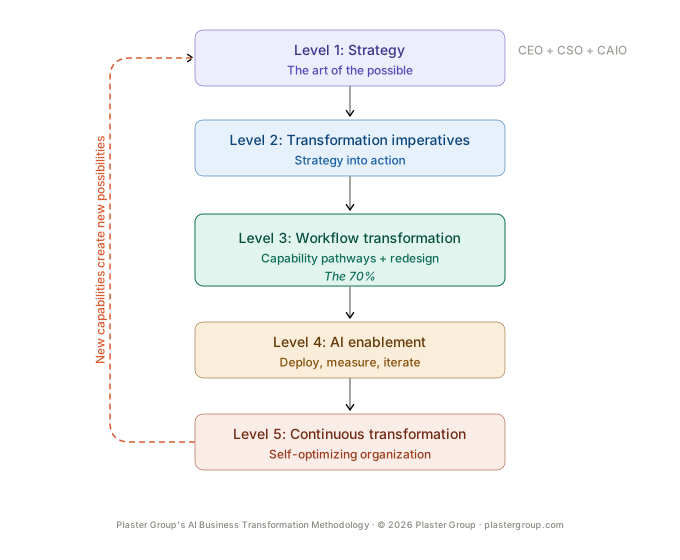
Your domain owner has received their charter. The capability decomposition is complete. You have a clear map of what the organization needs to be able to do that it cannot do today. The natural instinct is to move directly into redesigning workflows.
Do not do this yet.
The teams who will redesign your workflows, the directors and senior managers who will evaluate their quality, the managers who will QA them, and the analysts who will do the design work, need to understand what AI makes possible in their specific domain before they put pen to paper. Without that understanding, they will design workflows trapped in the assumptions of the technology era they grew up in. They will produce incremental improvements when they should be producing transformative redesigns. And the directors and senior managers who are supposed to serve as quality gatekeepers will not have the fluency to distinguish between a bold design and a conservative one.
This is Phase 3B: the education cascade. It is the most frequently skipped phase in the entire framework, and skipping it is the single most reliable way to ensure that Level 3 produces disappointing results.
Why does traditional AI training fail?
Traditional AI training fails because it teaches tools and concepts in the abstract rather than building fluency through application in a person’s actual domain — and the data on this is unambiguous. Most organizations that invest in AI education get it wrong for exactly this reason.
BCG’s AI at Work 2025 survey of more than 10,000 employees found that only 36% believed their AI training was sufficient.1 Eighteen percent of regular AI users said they received no training at all. Frontline workers had hit what BCG called a “silicon ceiling,” with adoption stalled at 51% while leaders and managers ran at 72%.1 A year later, the ceiling broke. BCG’s AI at Work 2026 survey of 11,749 workers across 14 markets, published June 3, 2026, found frontline regular AI use surged to 74%, up roughly 23 points.5 But the training problem did not disappear. It moved up a level: 72% of respondents now say AI has already considerably changed the skills their role requires, and among frontline users who save a full workday or more per week with AI, 66% get little or no guidance on what to do with the freed time.5 The gap is not a technology problem, and it is no longer an adoption problem. It is a fluency and guidance problem.
The reason most AI education fails is that it is generic. A half-day workshop on “AI for Leaders“ or an e-learning module on “Introduction to Machine Learning“ does not give a supply chain director the fluency to evaluate whether a proposed workflow redesign adequately leverages AI for demand forecasting. It does not give a finance manager the understanding to recognize when a proposed accounts payable workflow is under-designed. It does not give a business process analyst the knowledge to design a workflow that takes advantage of capabilities they have never experienced.
BCG’s research continues to find that one-size-fits-all rollouts fail, and that learning journeys must be tailored to distinct adoption personas, from AI champions to cautious skeptics.2 The companies BCG calls future-built plan to upskill more than 50% of their employees on AI, versus 20% for laggards; they are four times more likely to run structured AI-learning programs with protected learning time and five times more likely to do strategic workforce planning.2 The difference between generic AI training and domain-specific, role-specific AI education is the difference between an organization that can redesign workflows for AI and one that cannot.
What does substantive AI education actually look like?
Substantive AI education is not training in the traditional sense — it is a structured series of working engagements, run by the CAIO’s department and tailored to each level of the organization, where participants experience what AI can do in their specific domain and develop fluency through application rather than instruction.
The delivery mechanism matters as much as the content. BCG’s 2026 research argues that applied, in-workflow learning is displacing classroom and course models, and McKinsey’s current guidance on learning and development for the AI age makes the same move: continuous, contextual capability building embedded in the work itself.6 The cascade should be designed accordingly. Fluency building starts before the design work and continues through it, delivered as much as possible inside the work people already do rather than in a separate classroom phase that ends when the design begins.
For domain owners and VPs (which should have happened during Phase 3A as described in Article 10), the engagement focuses on strategic capability awareness: what is possible, what is achievable, and what changes the competitive calculus in their domain. The output is the ability to evaluate capability requirements and set the ambition level for the transformation.
For directors and senior managers, the engagement goes deeper into operational capability: what AI can do in the specific workflows they oversee, what the realistic performance envelope is, where AI excels and where human judgment remains essential, and what good workflow design looks like when AI is a component. This is the level where quality gatekeeping happens, so the education must produce fluency deep enough to distinguish a transformative design from an incremental one.
For managers, the focus is on team leadership in an AI-enabled environment: how to manage teams through workflow redesign, how to QA AI-integrated workflow designs for quality, and how to report progress and issues upward with enough specificity that directors and senior managers can make informed decisions. Treat this tier as a first-class engagement, not an afterthought folded into end-user training. Harvard Business Review’s June 2026 research found that middle managers absorb the new invisible work of AI adoption (validating AI outputs, catching errors, coaching teams on AI skills) with unchanged delivery pressure and no formal support structures.7 The cascade is where that support structure gets built.
For senior analysts and business process analysts, the engagement is the most intensive. These are the people who will do the actual design work. They need hands-on experience with AI capabilities relevant to the workflows they will redesign: what AI agents can do, how human-AI handoffs work in practice, what data requirements look like, what error modes to design around, and how to create workflows that leverage AI’s strengths while accounting for its limitations.
Who runs the education cascade?
The CAIO’s AI-Business Translators are the engine of the cascade. They design the engagements, tailor the content to each domain, facilitate the working sessions, and provide ongoing support as the teams move into workflow redesign.
This is one of the CAIO department’s highest-value functions at Level 3. As described in Article 5, the department exists precisely to bridge the gap between AI’s technical capabilities and the business teams that need to use them. MIT Sloan Management Review’s research on AI-driven productivity argues that organizations must take a “work-backward“ approach3, and the education cascade is what makes that approach possible. You cannot work backward from what AI enables if you do not understand what AI enables.
The engagements should be domain-specific, not generic. A session designed for the finance organization should use finance workflows, finance data patterns, and finance decision points as the context. A session designed for the supply chain organization should use supply chain scenarios. The CAIO’s team brings the AI capability knowledge. The domain teams bring the operational context. The combination produces fluency that neither could achieve alone.
One practical note: the CAIO’s department will learn as much from these engagements as the domain teams do. Every engagement deepens the CAIO team’s understanding of how the business actually operates, which makes their workflow design advisory (in the next phase) dramatically more effective. The education cascade is not a one-way transfer of knowledge. It is a mutual deepening that prepares both sides for the design work ahead.
How is the education cascade sequenced?
The education cascade flows from the top of the organization downward, with each level completing their engagement before the next level begins. This sequence is not arbitrary — it matters for two reasons.
First, the people at each level need to be able to set expectations and context for the level below them. When a director who has been through the engagement tells their manager “here is what I learned about what is possible in our area, and here is what I expect the workflow redesign to reflect,“ the manager enters their own engagement with a clear sense of the ambition level. When a manager who has been through the engagement briefs their analysts on what is achievable, the analysts enter the design work with a realistic frame for what bold design looks like.
Second, the quality gatekeeping structure only works if the gatekeepers are educated before the people whose work they are evaluating. If the analysts go through the engagement first and begin designing workflows, and the directors and senior managers have not yet built the fluency to evaluate those designs, the quality gate is meaningless. The cascade ensures that at every stage of the workflow redesign, the person reviewing the work has at least as much AI fluency as the person who produced it.
The typical cascade timeline runs three to five weeks depending on the size of the domain:
Week 1: Directors and senior managers (if not already completed during Phase 3A alongside domain owners and VPs).
Weeks 2-3: Managers, with specific focus on QA capabilities and upward reporting.
Weeks 3-5: Senior analysts and business process analysts, with the most intensive, hands-on engagement.
Isn’t spending weeks on education before redesign too slow?
No — the three to five weeks spent on education before workflow redesign is not slow, it is what makes the redesign work; skipping it produces designs trapped in pre-AI thinking. Domain owners under pressure to show progress will push back on this timeline. The objection is understandable and wrong.
It is also increasingly at odds with the evidence on urgency. Accenture’s June 2026 operations research found that 78% of executives say AI is advancing too fast for their training efforts to keep pace, and that 82% of companies at early operations maturity have no talent reinvention strategy at all.8 Gartner’s April 2026 study of AI projects in infrastructure and operations found that 38% of reported failures cite persistent skills gaps, and Gartner separately predicts that by 2027, 75% of hiring processes will include certifications or testing for workplace AI proficiency.9 IBM’s 2026 CEO Study expects 29% of employees to need reskilling for a different role and 53% to need upskilling for their current one between 2026 and 2028.10 McKinsey’s State of Organizations 2026 quotes an executive rule of thumb worth keeping: for every dollar spent on technology, five should be spent on people.11 The question is not whether the organization can afford three to five weeks of education. It is whether it can afford to keep designing without it.
The research consistently shows that organizations which invest in substantive education before redesigning workflows produce dramatically better outcomes than those that skip to the design phase. The MIT Sloan case study of a global financial services firm that took the work-backward approach achieved a 59% workload reduction and 40% cost savings3, precisely because the redesign teams understood what was possible before they started designing.
Conversely, organizations that skip the education phase produce designs that under-leverage AI. Those designs then need to be revised or abandoned during deployment when the teams discover capabilities they should have known about during the design phase. The rework costs more time than the education would have taken. The three to five weeks invested in the cascade saves months of rework later.
McKinsey’s own internal experience reinforces this. When they invested in educating all colleagues on their internal AI platform and encouraged employees to create their own agents, the result was nearly 17,000 employee-created agents on top of 150 centrally developed ones.4 Education did not slow them down. It unleashed the organization’s capacity to innovate.
What should you avoid when running the education cascade?
Do not outsource the education to a vendor. Vendor-run AI training teaches people how to use a specific vendor’s product. That is a Level 4 activity. The education cascade at Level 3 is about understanding what AI makes possible regardless of vendor, so that the workflow designs are technology-agnostic and capability-driven. The CAIO’s department, not a vendor, should run these engagements.
Do not make it optional. Every person who will be involved in the workflow redesign, from the director reviewing designs to the analyst producing them, must go through the engagement. Optional participation produces inconsistent fluency, which produces inconsistent design quality, which produces workflows that range from transformative to incremental within the same department.
Do not confuse education with communication. The change management workstream (Article 8) includes a communications strategy that keeps the broader organization informed about the transformation. That is communication. The education cascade is working fluency development for the specific people who will design, review, and implement the new workflows. They serve different purposes for different audiences.
Do not treat it as a one-time event. The initial cascade prepares teams for the design work. But as the workflow redesign progresses and as AI capabilities continue to advance, the teams will need ongoing access to the CAIO’s department for questions, capability updates, and advisory support. The cascade launches the fluency. The ongoing partnership sustains it.
How do you know a team is ready to move to workflow redesign?
Before transitioning to Phase 3C (workflow redesign), the domain owner and their VPs should assess whether the education cascade has produced the readiness the design phase requires.
The test is not a quiz. It is a practical assessment: can the directors and senior managers articulate what AI makes possible in their specific area and identify where existing workflows fall short of that potential? Can the managers explain what a well-designed human-AI workflow looks like and what they would look for during QA? Can the analysts describe specific AI capabilities relevant to the workflows they will redesign and explain how those capabilities change what is possible?
If the answer to any of these is no, the cascade needs additional time in those areas before the design work begins. Moving into workflow redesign with teams that lack the fluency to design ambitiously guarantees that the output will be incremental, and incremental redesigns do not justify the investment that Level 3 requires.
Sources
- 1.BCG, “AI at Work 2025: Momentum Builds, But Gaps Remain,“ June 2025 (10,635 employees, 11 countries). 36% training sufficient; 18% no training; silicon ceiling at 51% frontline vs 72% overall https://www.bcg.com/publications/2025/ai-at-work-momentum-builds-but-gaps-remain
- 2.BCG, “AI Transformation Is a Workforce Transformation,” 2026. Five adoption personas; future-built companies plan to upskill more than 50% of employees versus 20% for laggards; 4x structured AI-learning programs with protected learning time; 5x strategic workforce planning https://www.bcg.com/publications/2026/ai-transformation-is-a-workforce-transformation
- 3.Ravin Jesuthasan, “Want AI-Driven Productivity? Redesign Work,“ MIT Sloan Management Review, 2025. Work-backward approach; 59% workload reduction, 40% cost savings https://sloanreview.mit.edu/article/want-ai-driven-productivity-redesign-work/
- 4.McKinsey, “Reconfiguring Work: Change Management in the Age of Gen AI,“ August 2025. 17,000 employee-created agents on top of 150 centrally developed https://www.mckinsey.com/capabilities/quantumblack/our-insights/reconfiguring-work-change-management-in-the-age-of-gen-ai
- 5.BCG, “AI at Work: Why Strategy Matters More Than Tools” (4th annual edition), June 3, 2026 (11,749 workers, 14 markets). Frontline regular AI use at 74%, up roughly 23 points; 72% say AI has considerably changed the skills their role requires; 42% of frontline regular users save a workday or more per week; 66% get little or no guidance on using the freed time https://www.bcg.com/publications/2026/ai-at-work-why-strategy-matters-more-than-tools
- 6.BCG, “AI Is Moving Corporate Learning Out of the Classroom and Into Workflows,” 2026; McKinsey Organization Blog, “Reimagine Learning and Development for the AI Age,” 2026. Applied, in-workflow learning displacing classroom models; continuous, contextual, embedded capability building https://www.bcg.com/publications/2026/ai-is-moving-corporate-learning-out-of-the-classroom
- 7.Harvard Business Review, “AI Adoption Is Overloading Your Middle Managers,” June 2026. Middle managers absorb AI validation, error-catching, and coaching load without formal support structures https://hbr.org/2026/06/ai-adoption-is-overloading-your-middle-managers
- 8.Accenture operations survey, reported by Forbes (Moor Insights), “Accenture Survey Finds AI Investment Surging, But Operating Models Lag,” June 24, 2026. 78% of executives say AI is advancing too fast for their training efforts; 82% of early-maturity companies lack a talent reinvention strategy https://www.forbes.com/sites/moorinsights/2026/06/24/accenture-survey-finds-ai-investment-surging-but-operating-models-lag/
- 9.Gartner, “AI Projects in Infrastructure and Operations Stall Ahead of Meaningful ROI Returns,” April 7, 2026 (782 infrastructure and operations leaders): 38% of reported failures cite skills gaps. Gartner Data & Analytics Summit, March 2026: 75% of hiring processes to include workplace AI proficiency certification or testing by 2027 https://www.gartner.com/en/newsroom/press-releases/2026-04-07-gartner-says-artificial-intelligence-projects-in-infrastructure-and-operations-stall-ahead-of-meaningful-roi-returns
- 10.IBM, 2026 CEO Study, released at Think 2026, May 4, 2026 (2,000 CEOs and senior leaders, 33 geographies). 29% of employees expected to need reskilling for a different role and 53% upskilling for their current role between 2026 and 2028 https://newsroom.ibm.com/2026-05-04-ibm-study-ceos-are-reshaping-c-suite-roles-for-the-ai-era
- 11.McKinsey, “The State of Organizations 2026,” 2026 (10,000+ senior executives, 15 countries). For every $1 spent on technology, $5 should be spent on people; people-first organizations 4x more likely to sustain top-tier financial performance https://www.mckinsey.com/capabilities/people-and-organizational-performance/our-insights/the-state-of-organizations
Frequently Asked Questions
We already have an AI training program. Is that not sufficient?
It depends on what the program covers. If it teaches general AI concepts, prompt engineering, or specific vendor tools, it is useful but not sufficient for Level 3. The education cascade is domain-specific fluency development that prepares people to design new workflows for their specific operational context. General AI training makes people comfortable with AI. The education cascade makes people capable of redesigning their work around AI. Both have value. Only the second prepares your teams for the design work ahead.
How do we handle employees who are resistant to the education process?
Resistance at this stage usually comes from one of two sources: fear (employees worried that learning about AI means learning to automate themselves out of a job) or skepticism (experienced operators who do not believe AI can do what the engagement claims). Both are addressed through the engagement itself. When employees experience what AI can actually do in their domain, fear often transforms into curiosity and skepticism transforms into creative engagement. The domain owner’s role is to frame the education as preparation for redesigning work in a way that makes human contributions more valuable, not less. Article 1 in this series provides the evidence base for this framing.
What if the CAIO’s department does not have enough capacity to run engagements for all domains simultaneously?
They should not try. The education cascade runs domain by domain, aligned with the sequencing of the Level 2 portfolio. First-wave domains go through the cascade first. Second-wave domains go through it later. This is not a limitation. It is the natural consequence of the waves-not-waterfall approach described in Article 4. The CAIO’s team also builds reusable engagement frameworks over time, making each subsequent domain’s cascade faster and more refined.
Should external consultants be involved in the education engagements?
External expertise can supplement the CAIO’s department, particularly if the department is still being built or if specific technical capabilities require specialized knowledge. But the engagements should be led by the CAIO’s team, not outsourced to an external firm. The CAIO’s team needs the deep domain understanding that comes from facilitating these engagements, and that understanding is what makes their workflow design advisory effective in the next phase. Outsourcing the education outsources the learning.
How do we maintain AI fluency over time as capabilities evolve?
Build ongoing touchpoints into the operating model. Quarterly capability updates from the CAIO’s department, embedded AI advisors who participate in workflow design and iteration cycles, and access to new capability demonstrations as the technology advances. AI fluency is not a destination. It is a capability that must be maintained and deepened as the landscape evolves.
This series addresses “what” to do, not “how” to do it. If you are a business executive and would like help thinking through the “how,” please feel comfortable reaching out.
Previous: Article 10: Capability Decomposition · Next: Article 12: Workflow Redesign for AI
© 2026 Plaster Group, LLC. All rights reserved. This article may not be reproduced, distributed, or transmitted in any form without prior written permission from Plaster Group. Brief excerpts may be quoted for review or commentary purposes with attribution to the author and a link to the original article.
Ready to move forward?
Let's discuss how your organization can build with AI — securely, strategically, and starting from where you are today.
Start a Conversation